
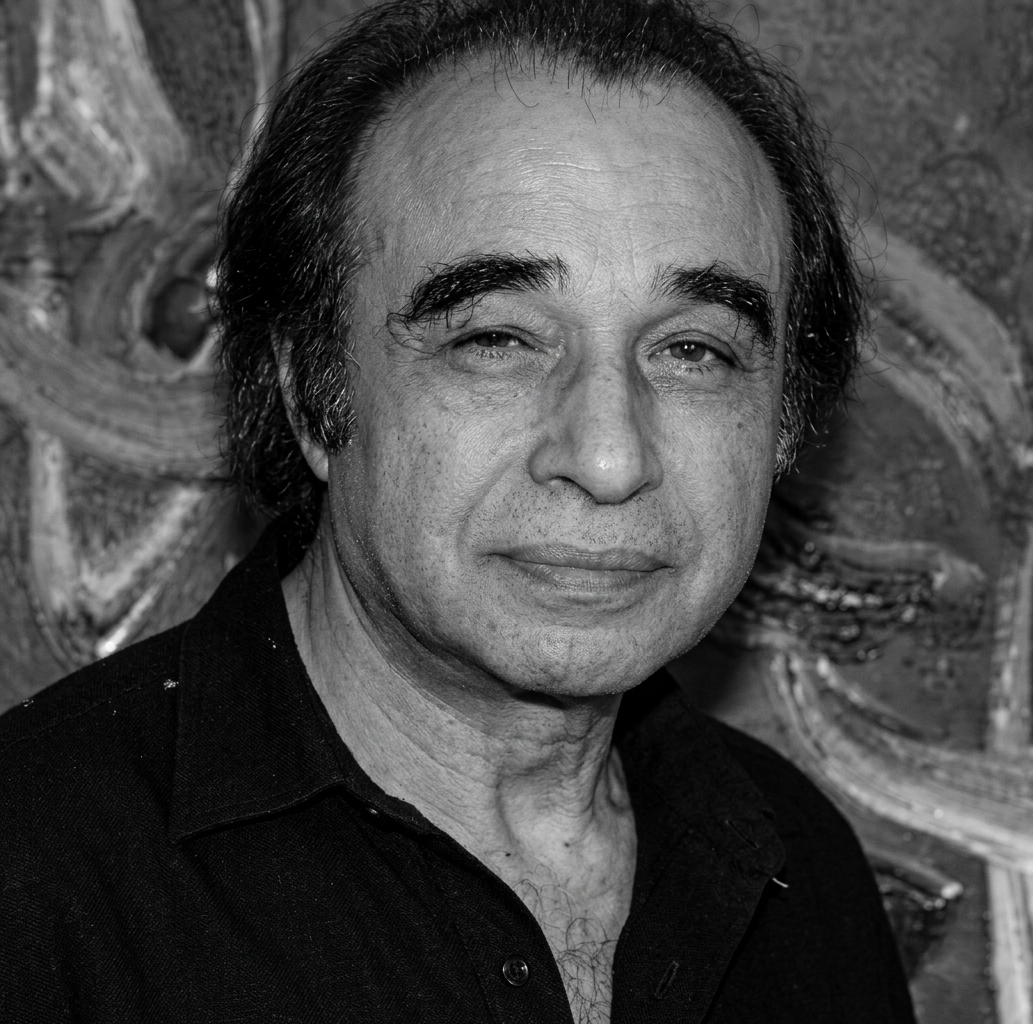
Ismail Gulgee , widely known simply as Gulgee, stands among the most influential figures in the history of modern Pakistani art. Born on 25 October 1926 in Peshawar, Gulgee developed a remarkable artistic language that merged Islamic calligraphy, abstract expressionism, and dynamic gestural painting, placing him at the forefront of Pakistan’s international artistic presence during the second half of the twentieth century.
Gulgee received his early education at Lawrence College, Murree, before pursuing higher studies in civil engineering at Aligarh Muslim University. His academic journey later took him to the United States, where he studied at Columbia University and Harvard University. Although trained as an engineer, it was during his time abroad that his passion for painting emerged, eventually leading him to dedicate his life entirely to the visual arts.
In the early phase of his career, Gulgee gained recognition as a portrait painter of extraordinary skill. By the late 1950s he had painted numerous prominent personalities, including members of the Afghan Royal Family and leading political figures. His reputation quickly expanded internationally, and he was commissioned to create portraits of global leaders such as U.S. Presidents Jimmy Carter and George H. W. Bush, the Shah of Iran, King Hussein of Jordan, King Faisal of Saudi Arabia, and prominent Pakistani leaders including Zulfikar Ali Bhutto and President Ayub Khan.
During the early 1960s, Gulgee underwent a decisive transformation in his artistic practice. Moving away from portraiture, he began to explore abstract painting inspired by Islamic calligraphy. His work evolved into large, energetic canvases characterized by sweeping gestures, bold textures, and luminous surfaces. Drawing inspiration from the international Action Painting movement, Gulgee reinterpreted Arabic and Urdu letterforms into powerful visual compositions that conveyed rhythm, spirituality, and movement.
His paintings often incorporated unconventional materials such as gold leaf, silver leaf, mirror fragments, and thick impasto, creating works that blur the boundaries between painting and mixed media. Through this unique approach, Gulgee developed a signature style that fused traditional Islamic aesthetics with modern abstract expressionism, earning him international recognition.
In addition to painting, Gulgee also created calligraphic sculptures, particularly in bronze, many of which were inspired by Quranic verses and Arabic letterforms. These works extended his exploration of calligraphy into three-dimensional space, reinforcing his role as one of the most innovative interpreters of Islamic visual tradition in contemporary art.
Gulgee’s works are held in numerous prestigious public and private collections around the world. Notably, several of his works are installed in important architectural and cultural sites, including the Faisal Mosque in Islamabad, where his artistic vision contributes to one of Pakistan’s most iconic religious landmarks.
Today, the legacy of Gulgee continues to be preserved and celebrated by major collectors and galleries. Hamail Art Gallery, Lahore, holds an important collection of Gulgee’s works representing different periods of his career. Through its curated holdings, the gallery plays a significant role in safeguarding and presenting Gulgee’s artistic heritage to collectors, scholars, and art enthusiasts, reaffirming his enduring place in the narrative of modern Pakistani art.
Gulgee’s life came to a tragic end in December 2007, when he, his wife Zarrin Gulgee, and a household employee were murdered at their residence in Karachi. Despite this tragic chapter, Gulgee’s artistic legacy remains undiminished. His work continues to inspire new generations of artists and collectors, standing as a testament to the powerful synthesis of spiritual calligraphy and modern abstraction that defined his extraordinary career.
Gulgee is survived artistically by a lasting body of work and personally by his son, Amin Gulgee, himself an internationally respected contemporary sculptor.