
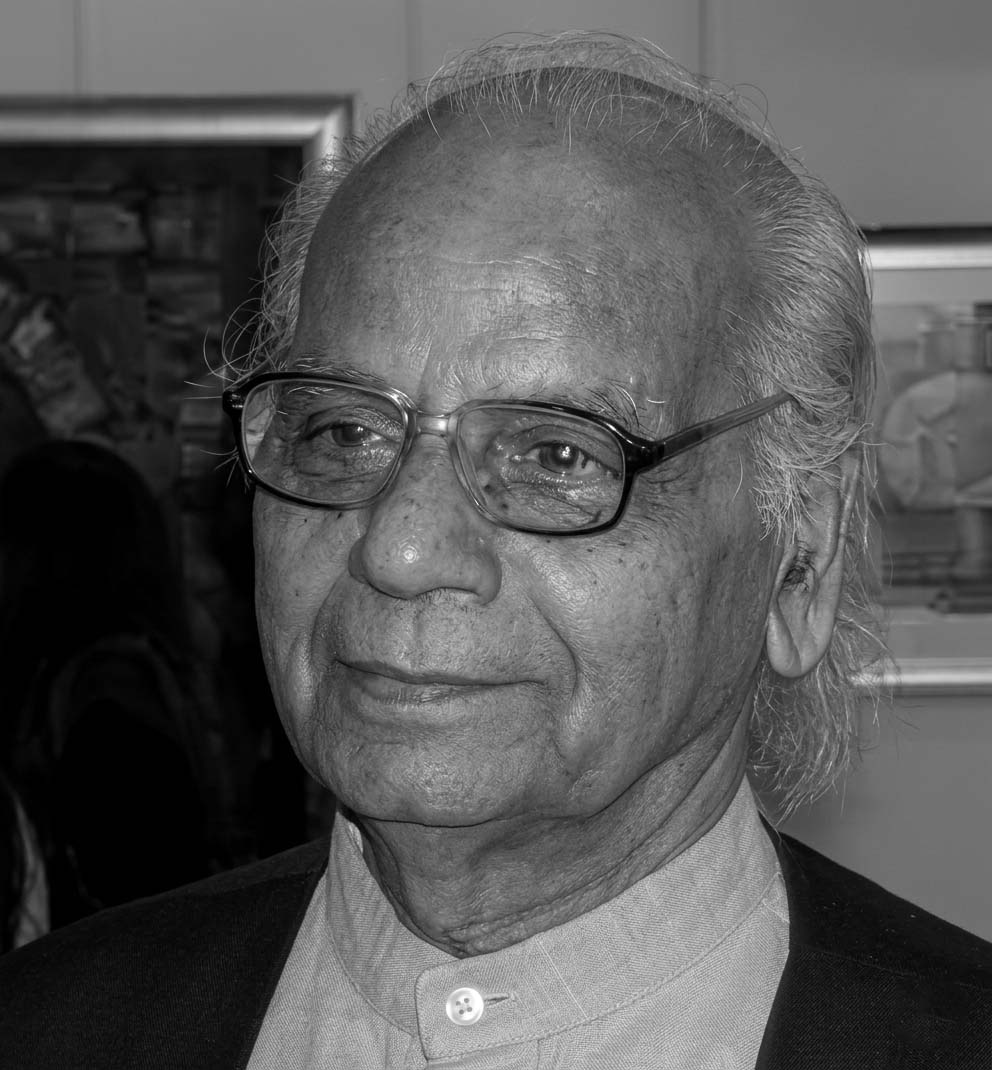
Born: 1938, Shahjahanpur, Uttar Pradesh, India
Ahmed Khan is a distinguished Pakistani artist, educator, and designer whose multidisciplinary practice spans painting, printmaking, sculpture, environmental art, and calligraphy. Widely respected for his innovative experimentation with materials and techniques, Khan has played a significant role in shaping the modern visual arts landscape of Pakistan.
Khan began his academic career at the National College of Arts (NCA), Lahore, where he joined as a Lecturer in Graphic Design in 1963. Over the course of more than two decades of service, he contributed profoundly to the development of art education in Pakistan and eventually served as Head of the Department. His teaching career at NCA continued until 1988, during which he mentored generations of artists and designers who later became influential figures in the Pakistani art scene.
Throughout his career, Ahmed Khan has received numerous prestigious recognitions. Among the most notable is the Shakir Ali Award (1996), regarded as one of Pakistan’s highest honors for modern painting. Earlier accolades include First Prize in Painting at the Lahore Biennials International Exhibition (1987) and First Prize in Sculpture at the National Exhibition in Islamabad (1983–84). In recognition of his artistic contributions and academic excellence, he was also awarded the National College of Arts Fellowship in 1976. As a student, he received the Kipling Award in 1963, the highest distinction awarded to the best graduate of the National College of Arts.
Ahmed Khan’s work has been exhibited widely in both national and international contexts. His works have appeared in major exhibitions across Asia, Europe, and North America, including exhibitions in London, Delhi, Muscat, Malaysia, China, Iran, Canada, and the United States. Notable group exhibitions include Lantern of the East at the 16th Pyeongtaek International Art Festival in Korea (2006), Transcending Borders in New Delhi (2006), and Art of Giving at the Long Room, Lord’s Cricket Ground, London (2005). His work has also been featured in exhibitions at the Asian Pacific Museum in California (1995–96) and Asia House, London (2000).
Ahmed Khan has held several solo exhibitions, including “Image of Faith” at Clifton Art Gallery, Karachi (2000) and subsequent exhibitions at Clifton Art Gallery and Canvas Art Gallery, Karachi (2001–2003). These exhibitions showcased his exploration of spiritual symbolism and his innovative use of materials.
Beyond the gallery space, Khan’s practice extends significantly into public art and environmental design. He has designed and executed numerous monuments and large-scale installations across Pakistan. Among these are the calligraphic sculptural monument “Alif-Lam-Meem” in Lahore Cantonment (1991–93), the Girja Chowk Environmental Monument (1988–90), and several environmental sculptures for Lahore Zoo (1985–86). He also designed monumental works for Lahore and Islamabad Airports (1981–82) and the Civil Aviation Authority Campus in Hyderabad (1983–84), integrating sculpture, environmental graphics, and architectural art.
Khan’s artistic research and experimentation have also led him to develop a unique technique combining silver and gold leaf with chemical reactions and transparent pigments, which he applied in several commissioned projects. One of his most significant commissions was the design and execution of the interior artistic work of the National Assembly Hall of Pakistan (1995–97). His artistic commissions have also been undertaken for major institutions including Al-Faisal Islamic Investment Bank and Askari Commercial Bank.
Earlier in his career, Khan was invited to participate in a printmaking workshop in Venice, Italy (1970–71). He also worked closely with the renowned American printmaker Ponce de Leon between 1966 and 1971, producing prints that were later included in the collections of the Library of Congress and the Smithsonian Institution in the United States. These works were also featured in the Pratt Institute Graphic Annual and exhibited in the Tokyo Printmaking Biennial.
Ahmed Khan’s artistic research has extended into cultural documentation as well. Between 1963 and 1965, he conducted a nationwide folk art research program across Pakistan and organized an exhibition of Pakistani folk art at the Commonwealth Art Festival held at the Royal Festival Hall in London.
Today, Ahmed Khan is recognized as an important figure in Pakistan’s modern art history. His works are held in private and institutional collections and have been widely reproduced in both national and international art publications. His contributions as an artist, educator, and public art designer continue to influence the development of contemporary art in Pakistan.